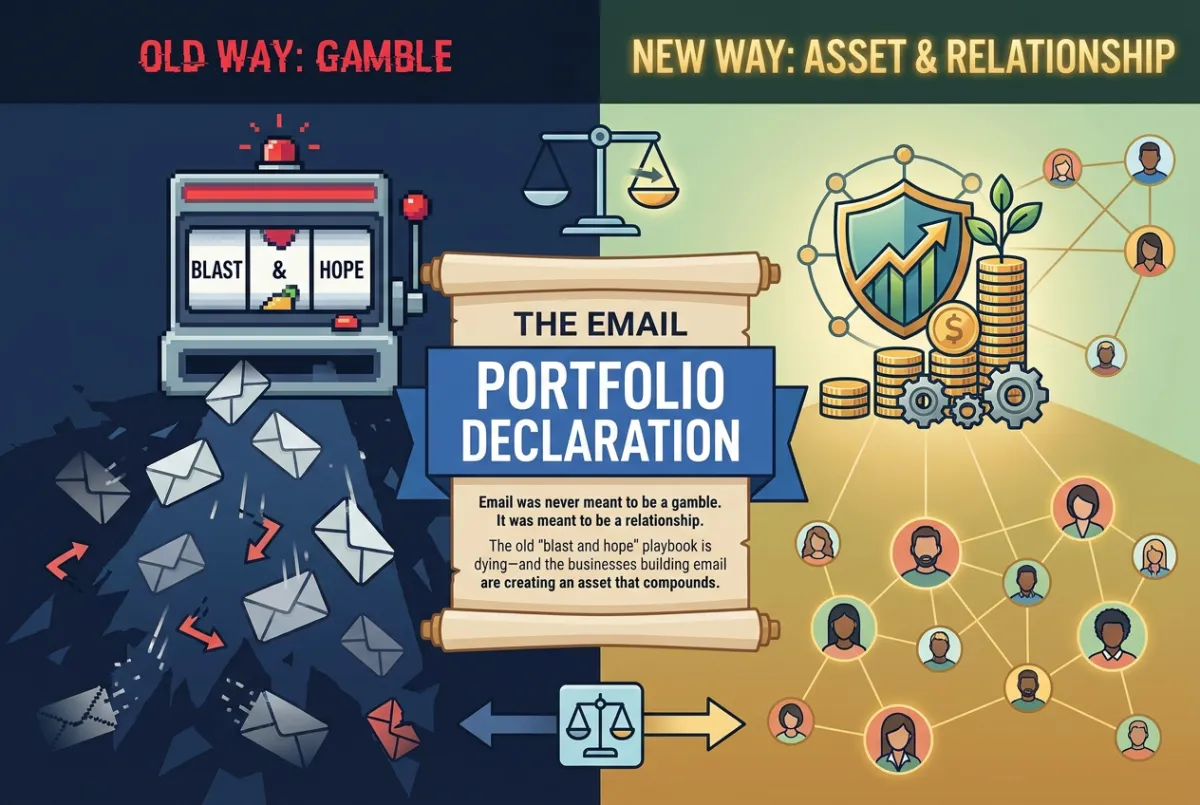
The Email Portfolio Declaration
Email was never supposed to feel like a gamble.
It was supposed to be the most direct relationship channel ever created - no algorithm deciding who sees it, no reach percentage to optimize, no platform that can pull your audience out from under you.
Just a sender, their words, and the person who chose to let them in.
That was the original promise.
And for most coaches, consultants, and professional service providers, somewhere along the way, it became something else entirely.
Not on purpose. Most of us just followed the playbook everyone handed us.
Build a list. Set up a sequence. Hit send. Repeat. Grow the numbers, monitor the metrics, blast and hope.
And for a while, it worked.
Until the engagement that once felt effortless started fading - fewer opens, fewer clicks, no replies - and we convinced ourselves that was just how email worked now.
Until email started feeling like shouting into a room where nobody's really listening.
The financial advisor sending market updates to a list that stopped responding months ago.
The coach whose nurture sequence runs on autopilot while real relationships quietly die.
The real estate agent, the consultant, the course creator who got a client from email once - and has no idea how to repeat it.
That is not a list problem. That is a relationship problem.
The platforms didn't change to punish good senders. They changed because of what the old playbook turned email into.
And the senders still running that playbook are finding out, one dead campaign at a time, that the world they built their strategy around has moved on.
This is not a problem that gets easier to solve later.
Every week a sender keeps blasting a list instead of building a portfolio, another sender is compounding a real relationship with the same kind of audience. The gap grows every single day.
I refuse to believe that a subscriber is just a number on a dashboard.
I refuse to accept that hitting send is a gamble - that you blast and hope and wonder if anyone saw it.
I refuse to measure the health of an email list by how many people are on it. The size of the list is a starting point. The strength of the relationship is the asset.
I am not satisfied sending to people who don't remember signing up.
I am not satisfied watching engagement decay and calling that normal.
I am not satisfied treating the people on my list - human beings who trusted me enough to hand over access to the most personal corner of their digital lives - like targets in a sequence.
There is a different way to build this.
I call it the email portfolio.
A list is names in a database.
A portfolio is compounding trust.
It grows through earning, through showing up consistently, through becoming someone your subscribers actually want to hear from, through treating the inbox as the sacred space it actually is.
Turning a list into a portfolio - auditing what you have, rebuilding the relationship with your subscribers, managing it with the same discipline a serious investor brings to their holdings over time - is not a passive undertaking. It demands real commitment before it returns anything.
Not everyone is ready to do that work. But the senders who are will end up with something most email marketers will never have.
I have seen what is possible when someone commits to this the right way.
I have seen the coach who opens their laptop on a Tuesday morning and hits send with certainty because the relationship was already there long before the offer appeared.
I have seen the financial advisor who sent one genuinely thoughtful email and had three clients forward it to people they knew. Without being asked.
I have seen the consultant whose client said: "I've been reading your emails for two years. I didn't need to get on a call to know I wanted to work with you."
I have seen Stripe notifications arriving one after another because months of genuine relationship made that campaign inevitable.
That is what email actually is, when it is treated like what it is.
The most powerful relationship channel ever created. A revenue asset that compounds every single year. An inbox presence that earns its right to be there.
And so here is what I believe:
I believe email is the most powerful relationship channel ever created - and it only performs at that level for the senders who treat it like one.
I believe the inbox is sacred. The people on your list gave you access to the most personal corner of their digital lives. That trust is the foundation of everything that follows.
I believe the new standards of email delivery are a filter, not a burden. The senders who rise to meet them are building an advantage that compounds every year as the rest of the market fades.
I believe that an email portfolio - built on genuine relationship, protected with discipline, managed with intention - is one of the most durable revenue assets a coach, a consultant, or a professional service provider can own.
I believe the work is worth doing.
And I believe it begins now - not after the next launch, not when things settle down, now.
Google, Microsoft, Apple, and Yahoo are not done changing. The standards they set today will be raised tomorrow.
The senders who begin this work now are not catching up. They are getting ahead. Every month of genuine relationship built today becomes a competitive advantage that compounds next year and the year after.
The early investor doesn't wait for the opportunity to become obvious. By the time it is obvious, the advantage is gone. The senders who understand what email is becoming - and start building accordingly - are the ones who will be positioned when everyone else is still trying to figure out what changed.
That window is open now.
This is the declaration. Of what I'm building, how I work, and who I'm building it with going forward.
The people who do this work are not looking for a shortcut.
They have accepted what changed, and they are building something that lasts - something that compounds, something that grows, something that earns more trust every year than it did the year before.
If you have been nodding since the first line -
You are already one of them.
~ Scott Hartley, Hit The Inbox™


