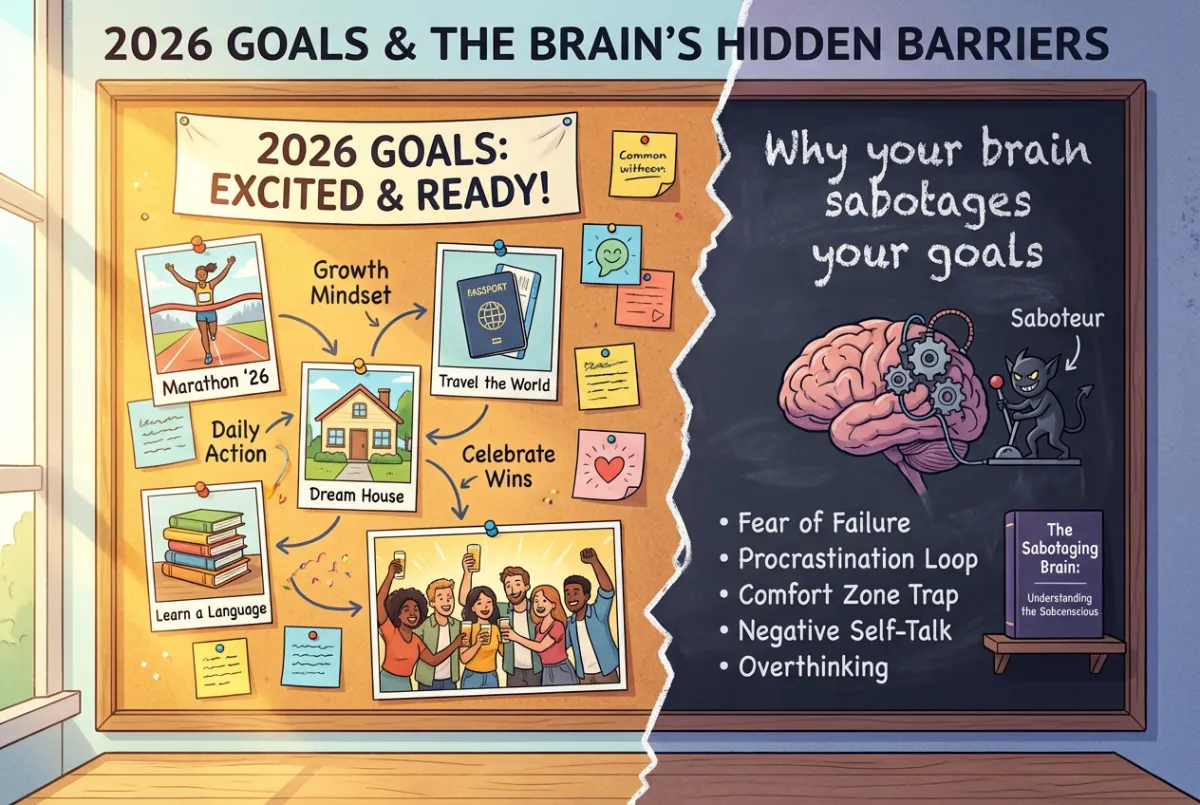
Why your brain sabotages your goals (even when you're motivated)
I go to the gym three mornings a week around 6 AM.
The same five or six of us nod at each other as we complete our sets ... because who wants to have a conversation when you've not had your first cup of coffee yet.
January 2nd that'll change.
Folks I've never seen step foot into the Y will be suddenly committed to getting fit.
But give it two weeks ... likely less.
I'll no longer have to wait my turn for the bench press or free weights.
The new people will vanish like they were never there.
Same thing happens with goals every single year.
Everyone gets excited. They buy the planner or sign up for the course or join the mastermind.
Then two weeks pass and the excitement wears off and they're back to doing exactly what they were doing before.
But what if the problem isn't the goals?
What if it's something running in the background of your brain that keeps pulling you back to your old patterns no matter how motivated you feel?
Over the holidays, I read a book called Inner Excellence by Jim Murphy.
Murphy talks about ten foundational beliefs - he calls them "empowering presuppositions," which sounds academic but really just means "the core assumptions your brain operates from."
These aren't things you consciously think about.
They're the invisible rules running in the background. The thermostat that keeps your life at a certain temperature whether you like it or not.
I'm going to share all ten of them with you because I think you need to actually read them and sit with them for a minute.
1. Every circumstance and every person you encounter is here to teach you and help you—it's all working for your good. You were created for glory (infinite, inherent worth). The life you've been given is meant to develop your character and prepare you for that glory.
2. Your life is a reflection of your beliefs. The foundation for extraordinary performance, joy and confidence—and the primary skill to learn—is how to believe. Beliefs are the control panel of your life, a subconscious thermostat, keeping your life in line with your comfort levels. To improve performance (and your life) in a consistent, powerful way, you must change your beliefs about who you are and what's possible.
3. Self-centeredness is the root cause of fear. It leads to self-consciousness (concern about what others think of us), overanalysis, and ultimately, self-rejection. Our greatest obstacle is getting in our own way through arrogance or self rejection, both of which come from self-centeredness.
4. We all have the same deep needs and same deep desires. Every human heart desperately wants to be loved and accepted; most of what we do is done in order to meet this need. Our deepest need is for unconditional love and our greatest desire is to be fully known and fully loved.
5. Everyone does the best they can with what they have (in their hearts). That is… according to their background, their understandings, their beliefs, their fears, their wounds, and their voids. Whenever someone (including yourself) acts in a way that is painful or hurtful, it is because they lack resources such as love, joy and peace, looking through a self-centered lens of fear or pain.
6. The map is not the territory. The world you see and interact with isn't reality; it's the one your mind created, based on the way you've interpreted and processed the events in your life so far.
7. You are not your mind. Your mind is a part of you that you need to train. You can learn to direct and control your thoughts, just like you learn to control your body. The greatest freedom you have is where to place your thoughts. As you realize that you are not your mind, you will be less attached to the useless, negative thoughts that come every day, and direct your mind towards empowering ones.
8. The problem is not the problem, the problem is the way you're thinking about it. You're not happy or sad because of your circumstances, but rather because of what you think about your circumstances. How you feel originates almost entirely from what you think; the state you enter caused by how you think about a problem is the real problem.
9. There's no failure, only feedback. Success and failure are highly interrelated, equally important, and labeled as opposites by our culture. Your ability to learn and grow and maximize your potential is directly correlated to your ability to embrace failure.
10. The person with the most control of their inner world has the most power. Mastery of the ego is the great challenge (and greatest opponent) in every competition. Selflessness—complete surrender—of the attachments, concerns and fears of the self, is the central component to extraordinary performance and cornerstone to creating beliefs that lead to absolute fullness of life.
Number nine is the one that got me.
"There's no failure, only feedback."
Because in 2026, I'm going to try things that make me feel awkward. Like recording more videos, which I've been avoiding because I hate feeling like I'm talking to myself.
I'm going to mess up. Probably a lot.
But I'm done calling it failure. It's just feedback. Data I can use to get better.
That one shift changes how I approach everything.
I'm genuinely curious ... which of the 10 resonated the most with you and why?
Hit reply and tell me.


